


Can a Narcissist Hide Behind Recovery on Social Media?

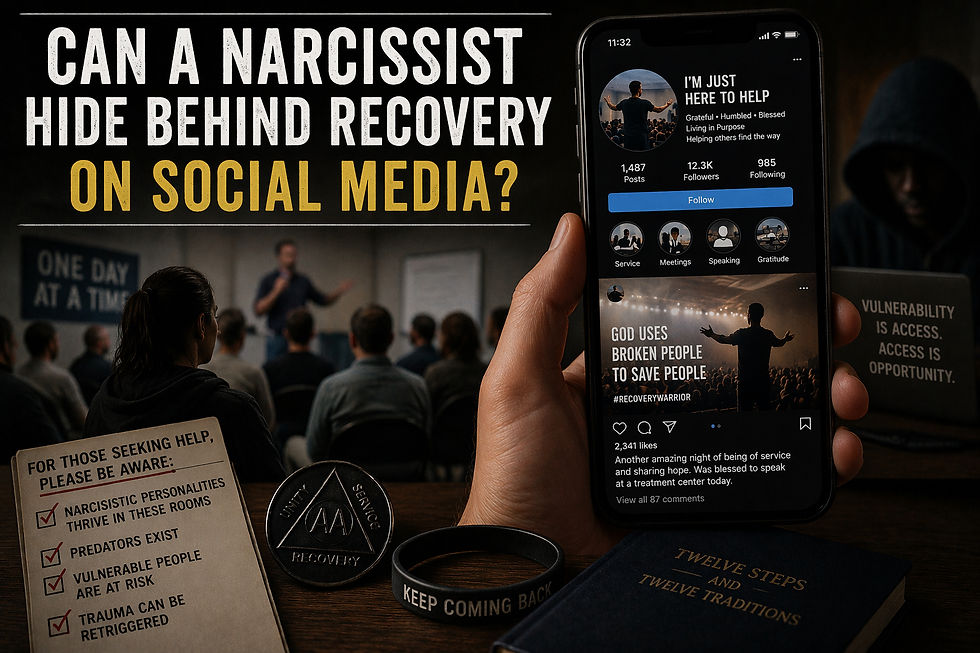
In behavioral health, one of the clearest indicators of meaningful recovery is congruence—the alignment between what an individual says, what they believe, and how they behave, particularly in close relationships.
As social media has become an extension of identity, it has also introduced a new layer to recovery: the ability to present it. While this can be beneficial, it also creates conditions where narcissistic tendencies can be reinforced, amplified, and, at times, concealed.
Narcissistic Traits and Exploitation of Systems
Narcissistic personality traits are not limited to grandiosity—they also include manipulation, exploitation, and lack of empathy. Individuals with these traits often form relationships that serve to regulate their self-esteem or elevate their status. (Frontiers)
Research consistently shows that narcissism is associated with:
- Interpersonal exploitation
- Devaluing others
- Using relationships for self-enhancement (ScienceDirect)
Importantly, narcissistic individuals do not just exploit people—they exploit systems. Any environment that offers:
- Attention
- Status
- Authority
- Access to vulnerable individuals
can become a space where these traits are reinforced.
Recovery Spaces: Supportive—and Vulnerable
Twelve-step programs like AA and NA are widely used because they are accessible, peer-driven, and effective for many individuals. Research shows participation is associated with improved abstinence and recovery outcomes. (PMC)

However, these environments are also:
- Peer-led
- Minimally regulated
- Built on vulnerability and disclosure
From a clinical standpoint, this creates a dual reality:
They are both healing environments—and high-risk interpersonal environments.
Notably, research has found that individuals entering AA can exhibit elevated levels of pathological narcissism compared to the general population. (PubMed)
This does not mean AA or NA “creates” narcissism—but it does suggest that:
👉 Individuals with narcissistic traits are already present within these systems
👉 And those traits do not automatically resolve through participation
Why Narcissistic Individuals Can Thrive in These Environments
When you apply known narcissistic patterns to the structure of recovery spaces, a clear dynamic emerges:
Narcissistic individuals are drawn to environments where they can:
- Be seen as leaders or mentors
- Gain admiration through storytelling or speaking
- Establish influence (e.g., sponsorship roles)
- Access emotionally vulnerable individuals
These environments unintentionally provide:
- Built-in audiences
- Hierarchies without formal oversight
- Cultural norms that discourage confrontation (“focus on yourself”)
From a clinical lens, this combination can allow narcissistic behaviors to be:
- Minimized
- Misinterpreted as confidence or leadership
- Reinforced rather than challenged
Trauma and Retraumatization
For individuals with a history of narcissistic abuse, this dynamic is not theoretical—it is experiential.
Narcissistic abuse often involves:
- Control masked as care
- Conditional support
- Emotional invalidation
- Power imbalances
When similar dynamics appear in recovery settings, even subtly, it can trigger:
- Hypervigilance
- Emotional shutdown
- Re-enactment of prior trauma
This creates a critical clinical issue:
The very environment intended to support recovery can, for some individuals, replicate the dynamics that caused harm.
Predatory Risk in Vulnerable Populations
It is well established in behavioral health that vulnerable populations attract opportunistic behavior.
Early recovery often includes:
- Emotional instability
- Isolation
- Desire for connection and belonging
Narcissistic traits—particularly exploitativeness and lack of empathy—can intersect with these vulnerabilities in harmful ways.
While not unique to AA/NA, peer-led environments without formal accountability increase the risk that:
- Boundaries are blurred
- Authority is misused
- Vulnerable individuals are targeted for emotional, relational, or even sexual exploitation
This is not a critique of the model itself—it is a recognition of human behavior within unregulated systems.
Social Media: The Amplifier
Social media does not create these dynamics—it amplifies them.
It allows individuals to:
- Publicly curate a recovery identity
- Display authority, recognition, and influence
- Expand access to vulnerable individuals beyond physical meetings
The same narcissistic patterns seen in rooms can extend online:
- Self-promotion disguised as service
- Authority without accountability
- Targeting of individuals who are visibly struggling
In this way:
- Meetings provide the environment
- Social media provides the reach
The Clinical Reality
There is limited direct research explicitly stating that narcissistic individuals “thrive” in AA/NA or that these spaces are inherently unsafe.
However, there is strong evidence that:
- Narcissistic individuals exploit relationships and systems
- Vulnerable populations are at increased risk of exploitation
- Peer-led environments rely heavily on informal boundaries
When these factors intersect, the risk is not theoretical—it is predictable.
Conclusion
AA and NA remain valuable and life-saving resources for many individuals.
But clinical integrity requires acknowledging a more nuanced reality:
Not all participants are safe.
Not all influence is healthy.
And not all recovery that is visible is authentic.
Social media has extended these dynamics into a broader, more accessible space—where identity, authority, and vulnerability intersect in ways that require greater awareness.
The question is no longer just whether someone is in recovery.
It is whether their behavior—online and offline—reflects the principles they claim to represent.


Comments